Miami-Dade County rests on permeable oolitic limestone and fine sandy loam that permit deep subterranean colonies of Coptotermes gestroi and Coptotermes formosanus to forage undetected beneath building pads. In…
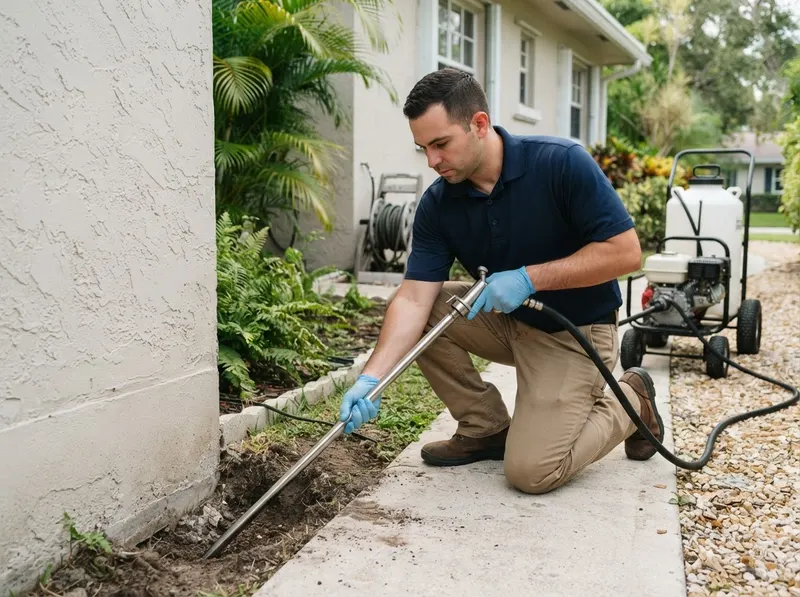
Miami-Dade County rests on permeable oolitic limestone and fine sandy loam that permit deep subterranean colonies of Coptotermes gestroi and Coptotermes formosanus to forage undetected beneath building pads. In neighborhoods like Coconut Grove, Silver Bluff, and Coral Gate, dense canopy shade and consistent ground moisture from tropical downpours preserve high humidity in the top 12 inches of soil, accelerating ground-nesting activity. A liquid termiticide soil barrier binds to soil particles, creating a treated perimeter trench 6 inches wide and 6 inches deep around every exterior foundation wall. Unlike baiting stations that rely entirely on exploratory worker feeding intervals, an unbroken chemical zone provides direct, structural-edge defense against mud shelter tubes entering through slab expansion joints or plumbing penetrations.
Properties located in high-density urban corridors like Brickell, Edgewater, and Wynwood frequently present abutting concrete walkways, paved pool decks, or tiled patios that sit flush against external stem walls. In these conditions, technicians drill vertical injection ports spaced 10 to 12 inches apart through the slab along the foundation, injecting termiticide under calibrated low pressure at a standard volume of 4 gallons per 10 linear feet. This saturated envelope prevents subterranean foragers from bypassing the exterior ground line. For historic crawl-space or pier-and-beam foundations found throughout Little Havana and Allapattah, the soil surrounding every individual masonry pier requires localized trenching and rod application to neutralize termite avenues rising toward wooden subfloors.
The structural choice between an exterior liquid soil barrier and recurring bait stations depends on foundation architecture and moisture volatility. If a structure features contiguous soil access along its perimeter, a liquid non-repellent barrier provides immediate interceptive control that operates continuously without requiring monthly cartridge checks. Conversely, if expansive interior concrete slabs prevent full perimeter saturation, monitoring stations serve as a complementary system. Modern non-repellent termiticides bind tightly to organic soil fractions, ensuring that standard Miami storm deluges and seasonal water table shifts do not wash the chemical horizon out of position. Routine on-site inspections verify that post-treatment landscaping, root expansion near Morningside Park, or utility installations have not fractured the contiguous perimeter line.
Every job gets a firm, written price after a free on-site visit.
Tell us about your subterranean termite soil barrier treatments job in Miami and we'll send a clear, written quote, usually the same day.
 Biscayne Falcon Pest Control