Miami-Dade County presents an ideal tropical breeding incubator for biting dipterans due to average relative humidity exceeding 70% and frequent coastal squalls. Culicoides biting midges breed aggressively in the wet,…
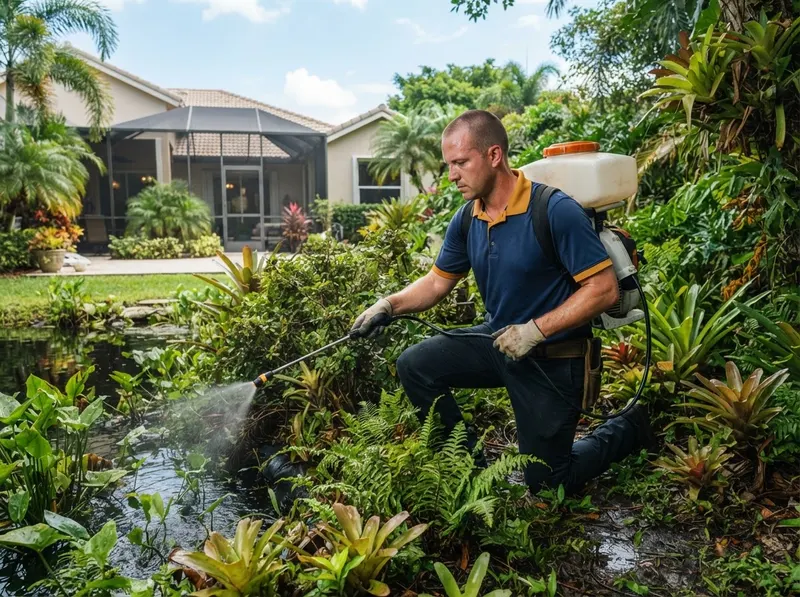
Miami-Dade County presents an ideal tropical breeding incubator for biting dipterans due to average relative humidity exceeding 70% and frequent coastal squalls. Culicoides biting midges breed aggressively in the wet, organic mangrove soil along Biscayne Bay in neighborhoods like Coconut Grove and Edgewater, while Aedes aegypti exploit micro-pools inside ornamental bromeliads, leaf axils, and catch basins across Brickell and Silver Bluff. Standard aerial spraying often fails to penetrate dense understory canopies near residential perimeters. Habitat suppression works by systematically dismantling these micro-environments through low-volume micro-encapsulated residuals applied to the underside of broadleaf foliage, paired with Bacillus thuringiensis israelensis (BTI) dunks placed directly into un-drainable water features.
Selecting localized barrier suppression over broad-scale space fogging depends on property layout and adjacent water exposure. Cold-fog space treatments yield an immediate knockdown within 30 minutes but degrade rapidly under direct ultraviolet radiation and provide zero residual deterrence. In contrast, micro-encapsulated polymer barriers bind to vegetation surfaces, withstanding Miami afternoon downpours and temperatures topping 90 degrees Fahrenheit for 21 to 30 days. Properties situated near tidal shorelines or dense urban tree canopies in Upper Eastside, Coral Gate, and Wynwood benefit from structural perimeter applications rather than ambient fogging, eliminating breeding reservoirs at the point of origin while preserving non-target pollinators active in upper flowering canopies.
Environmental resistance determines application frequency. High heat accelerates egg-to-adult emergence cycles from 14 days down to 6 days during peak summer months between May and October. In dense inland lots across Allapattah and Little Havana, concrete catchments, discarded containers, and dense palm boots harbor moisture reserves that remain wet between rain events. Technicians deploy targeted larvicidal granules into these secluded voids to stop pupation before the flying stage begins. Every site deployment follows three procedural steps: first, physical identification and mechanical draining of standing water sources; second, biological larvicide placement in essential aquatic reservoirs; third, directed hydraulic misting applied below four feet on perimeter foliage to establish predator-grade territorial control.
Every job gets a firm, written price after a free on-site visit.
Tell us about your mosquito and biting midge habitat suppression job in Miami and we'll send a clear, written quote, usually the same day.
 Biscayne Falcon Pest Control